


Our Story
Born from a
simple observation.
People loved Kalamkari. Nobody was making new patterns. Anusha decided to.
A Letter from the Founder
I’ve worn Kalamkari
my whole life. I just
wanted to see it worn
differently.
I am not a designer by training. I am a mother, someone who loves art, someone who has worn Kalamkari her whole life. That is where this started — not in a studio, but in a wardrobe.
I kept coming back to Kalamkari. The craft was everywhere, but the patterns had stopped evolving. What I could find was either the same designs repeated endlessly, or fabric that wasn't comfortable enough to actually wear. I wanted cotton that felt good on the body and prints I hadn't seen before. I couldn't find that. So I decided to make it.
The prints at VAYOMEIE are original — designed in-house, screen and block printed, coloured with natural dyes. Not interpretations of old motifs. New work, built on old knowledge.
Quality is the only thing I will not move on. Not to protect a margin, not to meet a deadline. If the fabric isn't right or the finish isn't clean, it doesn't go out. That is the whole standard.
“I trust what I am doing is going to be huge.”
She wants VAYOMEIE to be remembered for one thing: a good product. That is the whole ambition. Everything else follows from it.
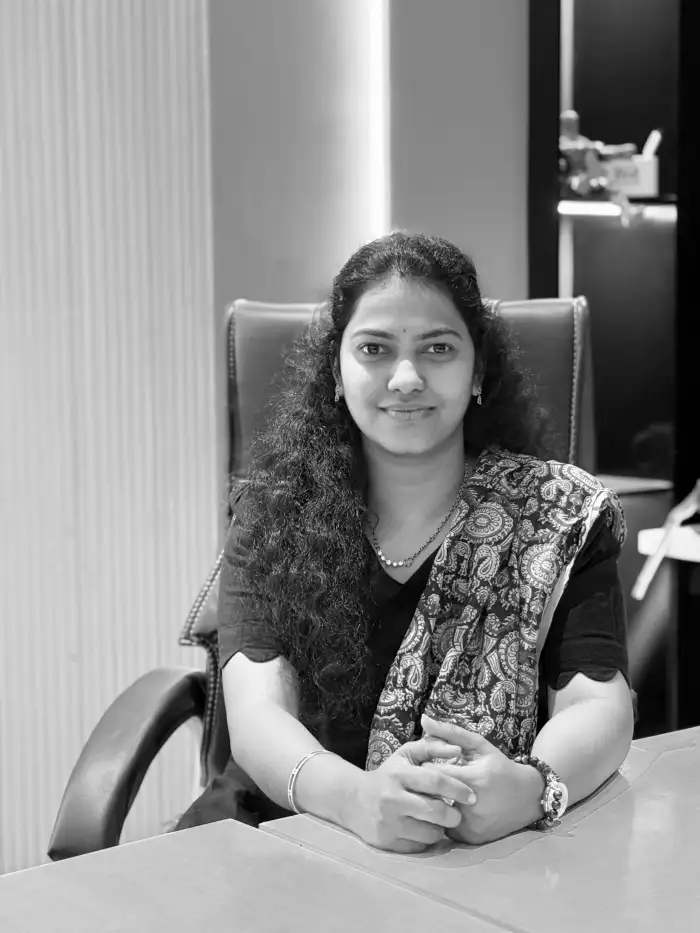
Anusha Shetty
Founder & Creative Director
The Process
Cotton. Natural dye. Original print.
01 — Where it begins.
The Cotton
Everything starts with the right fabric. We use cotton — chosen for how it wears against the skin, how it holds colour, and how it holds up over time. Comfort is not a secondary consideration. It is the first one.

02 — Colour from the earth.
Natural Dyes
We colour with natural dyes — indigo, pomegranate rind, madder root, iron water. No synthetics. The palette is quieter than what a chemical bath produces, and richer for it. Each piece holds colour with a particular depth that does not come from a formula.

03 — Original, every time.
The Print
Our prints are designed in-house and applied by screen or block. Each design is original — drawn from the Kalamkari tradition of Andhra Pradesh, but not copied from it. Ten designs at launch, each one a new pattern rather than a reproduction of an existing one.

Nine steps from raw cloth to finished garment.
Read the full fabric story →What We Stand For
Five positions.
None of them are negotiable.
01
Quality is not a selling point. It is the standard.
Every garment is checked by hand before it leaves. Finishing, stitching, print registration — if something is not right, it does not go out. There is no version of VAYOMEIE that compromises on this.
02
The fabric will never be sacrificed for the margin.
Cheaper fabric is always an option. We have chosen not to take it. The cotton we use costs more and performs better — in how it wears, how it holds dye, how it lasts. That choice is permanent.
“I will never compromise the fabric to protect the margin.”
— Anusha Shetty
03
Prints that do not exist anywhere else.
Every design is original — drawn from the Kalamkari tradition of Andhra Pradesh and developed in-house. We are not printing existing motifs. We are making new ones. That is the point of the work.
04
Good craft should reach everyone who wants it.
Quality clothing made with care should not be out of reach for the people who would actually wear it every day. We price with that in mind — fair to the work, fair to the customer.
“I want to reach all the audience who love quality.”
— Anusha Shetty
05
Build something that lasts.
VAYOMEIE is not a seasonal concept. The ambition is a brand with depth — one that grows because the product is genuinely good, not because of noise. That takes time and a refusal to cut corners.
The Community
Part of a 3,000-strong Kalamkari tradition.


VAYOMEIE is part of the Kalamkari artisan community of Andhra Pradesh — a tradition of screen and block printers, dye specialists, and craftspeople that numbers over three thousand. We work within that community, not apart from it.
Ten tailors work in-house. Every garment is finished and checked on site before it ships. The craft does not stop at the print — it carries through to the last stitch.

